
Table of Contents
- What Brand Positioning Actually Means?
- Brand Positioning vs Market Positioning
- Why Your Customer's Mind Runs Out Of Room?
- Why This Actually Shows Up On The Balance Sheet?
- The Positioning Statement
- Mapping Where You Actually Sit
- The Different Ways You Can Position A Brand
- Volvo And And The Word It Owns
- Nirma vs Surf, An Indian Positioning War
- Where Positioning Goes Wrong
- How To Actually Build Yours?
- Validation - Is Your Position Actually True?
- What's Next in the Marketing Launchpad?
- Check Out Marketing Launchpad
What Is Brand Positioning?
Every product on a shelf, in an app store or on a search results page is fighting for the same three seconds of attention and positioning is the only thing that decides who actually wins it. You’ve already figured out what your brand is and what problem it solves and who you’re solving it for, and none of that matters if your customer can’t place you anywhere specific in their head once they’re actually standing in front of the decision.
What Brand Positioning Actually Means?
Philip Kotler defined brand positioning as designing a company’s offering and image so it occupies a distinctive place in the mind of the target market, and that definition has survived decades of marketing textbooks because it puts the decision where it actually belongs, in the customer’s head and not in your own website copy. Amazon Ads describes it as the unique value a brand presents to its customer, articulated through a positioning statement that balances aspiration with reality, and NIQ frames it as defining a brand in relation to the market, the competition and the wider public consciousness all at once. Different words, same underlying point. You don’t get to declare your position. Your customer decides it based on what they already associate you with and your only real job is nudging that association in a direction you actually chose instead of leaving it to chance.
This isn’t the same as branding and it isn’t the same as marketing either, even though the three get mixed up constantly, something I already went into properly in the last post. Branding is who you are. Marketing is how you tell people. Positioning is the narrow, specific claim about where exactly you sit compared to every other option already fighting for the same customer, and it’s the thing that makes the branding and the marketing actually mean something instead of floating around without a target.
Brand Positioning vs Market Positioning
Quick distinction worth making before going further, since the two terms get used almost interchangeably and they aren’t quite the same thing. HubSpot draws the line as brand positioning being about how customers perceive a brand, while market positioning is about a brand’s actual place within the competitive landscape, its market share, its pricing tier, its category footprint. One lives in the customer’s head, the other lives in spreadsheets and industry reports. You need both to actually understand where you stand, but this post, and the template attached to it, is specifically about the first one, the perception you’re trying to build and defend.

Why Your Customer's Mind Runs Out Of Room?
Al Ries and Jack Trout wrote a book in 1981 called Positioning: The Battle for Your Mind and the core idea in it still holds up better than most marketing theory from that decade. Their argument was that people don’t have infinite mental shelf space for brands, so they stack the ones they remember into a kind of ladder, ranked by category, and they usually only keep the top two or three rungs of any given ladder in active memory. Ask someone to name a soft drink and they say Coke before Pepsi almost every single time, not because Pepsi is worse, just because Coke got there first and never let go of the top rung.
What that means in practice is that positioning was never really about being the best. It’s about being the first, or the only, or specific enough that nobody else has bothered to claim that exact rung yet. It’s easier to own a word than to own a category and it’s easier to defend one clear claim than five vague ones and it’s easier to get remembered for something narrow than to get remembered for nothing at all. HubSpot’s own writing on this points at Band-Aid and Kleenex as the extreme end of this idea, positioning so strong that the brand name actually replaced the generic word for the entire product category in everyday conversation.
Why This Actually Shows Up On The Balance Sheet?
This part usually gets left out of positioning articles entirely, treated as a purely creative exercise instead of something with a measurable financial return, and that’s a mistake because the data on this is genuinely strong. Kantar partnered with Oxford University’s Saïd Business School to study 872 brands over a 12 year period to figure out what actually drives abnormal stock returns, meaning returns above what the market would normally expect, and the single biggest contributor they found wasn’t advertising spend or product quality on its own, it was difference. How distinctly a brand was positioned against its competitors predicted outperformance better than almost anything else measured.
The numbers get more specific from there. Kantar’s Blueprint for Brand Growth report found that brands who are meaningfully different to more people command up to five times the market penetration compared to brands low on that same measure, and can charge up to double the average category price point on top of it. Positioning isn’t the soft, fluffy part of marketing that gets cut when budgets tighten. It’s arguably the part with the clearest link back to actual revenue.
The Positioning Statement
Once you get that positioning is about claiming a spot and not about being generically good at everything, the actual next step is writing it down as one sentence, and there’s a template for that which marketers have leaned on since the 90s because it forces every important question into a single breath. Harvard Business School’s own guide to this calls it the art of staking out a piece of mental real estate through a differentiated value proposition, and describes the statement itself as an internal document, not something that’s ever meant to be public facing copy.
For [your audience], who [has this need], [your brand] is the [category] that [delivers this benefit]. Unlike [your main alternative], we [do this one thing differently].
In simple words, fill in the blanks honestly. In longer words, here’s what that actually looks like using a fictional example so nobody has to reveal their real business in a public post: “For busy home cooks who don’t have time to meal plan, TiffinBox is the subscription meal kit that delivers pre-portioned Indian regional recipes to your door. Unlike a food delivery app or a local dabbawala, we teach you to cook the dish yourself instead of just handing you a finished plate.” One sentence, and it already tells you the audience, the need, the category, the benefit and exactly who you’re positioned against. If you can’t write something like that about your own brand right now, that’s usually the tell that the positioning work hasn’t actually happened yet, no matter how good the logo looks.
Mapping Where You Actually Sit
A positioning statement is the claim. A positioning map is whether the claim holds up, and it’s simpler than it sounds once you sit down and do it. Pick the two things your audience actually cares about when they’re choosing between you and everyone else, price versus quality, simple versus advanced, mass market versus niche, whatever applies to your category, and draw them as a plain X and Y axis. Then plot yourself and three or four real competitors on it based on how people actually see each of you, not how you’d like to be seen.
Most people find one of two things when they do this honestly. Either they’re sitting in the exact same spot as a competitor with a bigger budget, which is a fight you lose before it starts, or there’s open space nobody’s touching, which is usually where the real opportunity was hiding the whole time.
The Different Ways You Can Position A Brand
Positioning isn’t one single move, it’s a small set of angles you can pick from, and most strong brands lean on one primary angle while borrowing lightly from a second. Smartsheet’s breakdown of this and a few other sources on positioning strategy generally converge on the same core list.
Price or value based positioning claims you’re the best deal available, regardless of what the actual price is, the way Walmart’s “Save Money. Live Better.” does. Quality or premium positioning claims the opposite end, superior craftsmanship or materials justifying a higher price, the space Apple and most luxury brands live in. Convenience positioning wins on friction removed rather than price or quality, Amazon’s entire model is built on this. Benefit or attribute positioning picks one specific functional or emotional benefit and owns it. Problem-solution positioning frames the entire brand around solving one specific pain point rather than a general category need. User based positioning claims a specific type of person rather than a specific product feature, think of brands that position themselves as being for creators, or for new mothers, or for first time investors. Competitor based positioning defines itself explicitly against a named alternative, the way Dollar Shave Club built its entire early identity around not being Gillette.
None of these are mutually exclusive, a lot of strong brands mix a primary one with a secondary one, premium and quality tend to travel together naturally, and so do price and convenience. What matters is knowing which one you’re leading with, because trying to lead with all of them at once is how you end up back at the beginning of this post, occupying no rung on anyone’s ladder at all.
Volvo And And The Word It Owns
Volvo is the example that shows up in almost every positioning book written since 1981 and it holds up because it’s such a clean case of attribute based positioning done without compromise. Instead of fighting Mercedes on luxury or Toyota on price, Volvo made a real engineering decision to build safety into the actual product, not just the ad copy, and it kept repeating that one claim for decades until safety became the automatic word people reached for the moment Volvo came up in conversation.
What makes it work is that it wasn’t only a slogan. Volvo gave away the patent for the three-point seatbelt in 1959 instead of keeping it for itself, and that single decision did more to cement the safety claim than any campaign could, because the company’s own choices backed up the thing it was claiming. That’s the difference between a position that survives contact with reality and one that’s just marketing copy nobody actually believes.
Nirma vs Surf, An Indian Positioning War
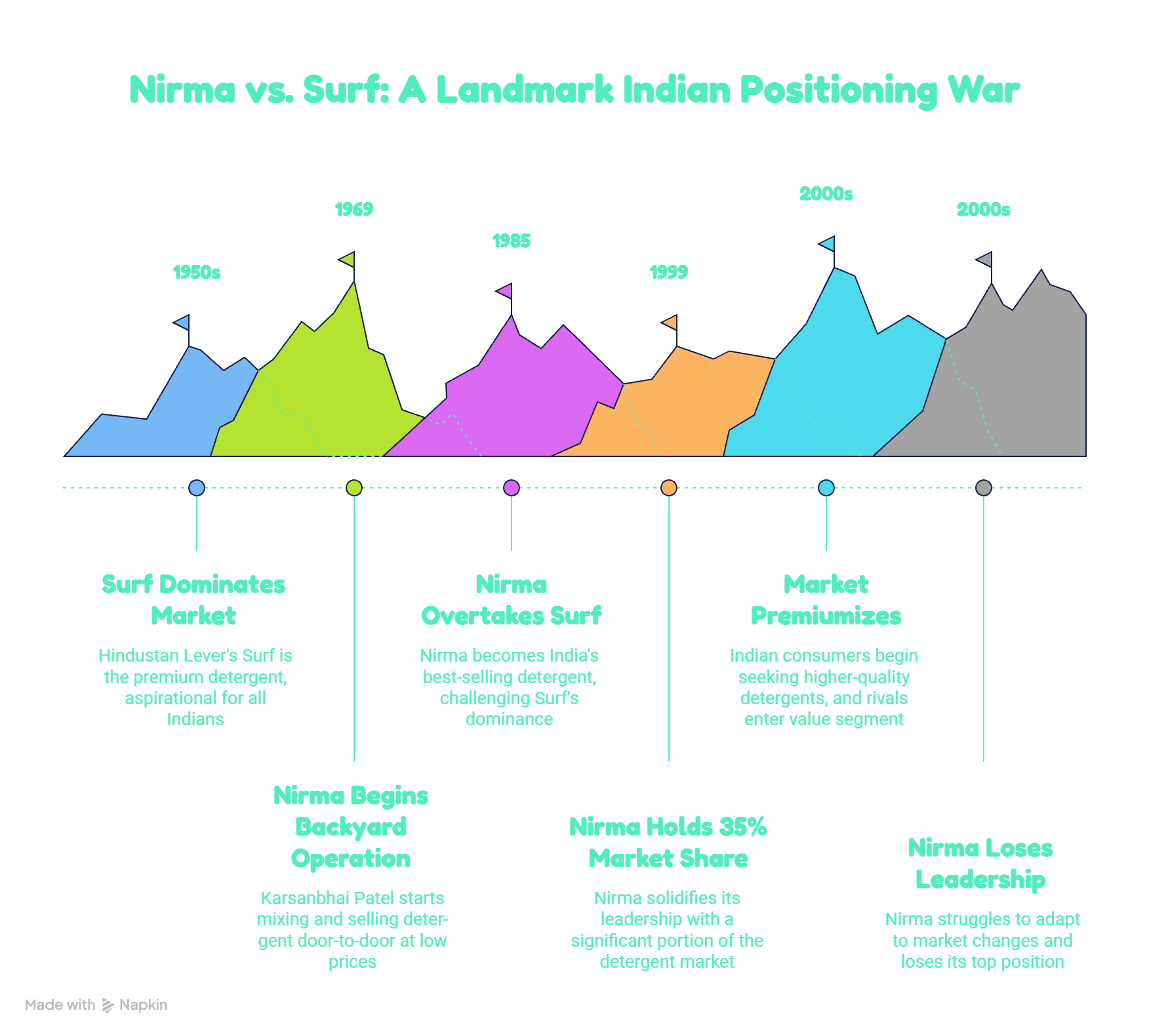
If you want a positioning story that’s entirely homegrown, and one that’s a textbook case of price or value based positioning specifically, the Nirma versus Surf detergent war from the 1980s is still taught in Indian business schools and for good reason. Hindustan Lever’s Surf had owned the Indian detergent market since the 1950s and had positioned itself as the premium option every household aspired to use, even the households who couldn’t really afford it. Then in 1969 a chemist named Karsanbhai Patel started mixing detergent powder in his backyard in Ahmedabad and selling it door to door at roughly Rs 3 a kilo, at a time when Surf cost around Rs 15.
Problem – Surf had spent decades convincing India that detergent meant premium and aspirational, which left an entire price-sensitive population feeling priced out of the category altogether.
Solution – Nirma didn’t try to argue it was better than Surf. It claimed a completely different rung on the ladder, value for money, and leaned hard into deliberately rural, unglamorous advertising that was the visual opposite of Surf’s urban, aspirational Lalitaji campaigns.
The bet worked, and it worked fast. By 1985 Nirma had overtaken Surf as India’s best selling detergent, and by 1999 it held over 35% of the entire market, which forced Hindustan Lever into an internal strategy meeting reportedly codenamed Operation STING, short for Strategy to Inhibit Nirma’s Growth. That a one-man backyard operation could force a multinational into that kind of war room says everything about how much a clean, specific position can outweigh a bigger budget.
There’s a part of this story most retellings skip, and it’s worth including because it’s the honest ending. Nirma’s whole position sat on one axis, low price, and when the Indian market started premiumising in the 2000s and rivals like Wheel and Ghari entered the exact same value segment, Nirma had nowhere else to go and slowly lost the leadership it had fought so hard to win. It’s not a reason to avoid a sharp position, it’s a reason to make sure the position you pick has room to grow with the business instead of trapping you inside the one word you first got famous for.
Where Positioning Goes Wrong
The most common mistake isn’t picking the wrong position, it’s refusing to pick one at all. A lot of businesses try to be positioned as high quality, affordable, innovative, and trustworthy all at once, and the result is that they don’t actually occupy any specific rung in anyone’s head because they never gave the customer a clear enough reason to file them under one word instead of four. This is exactly the trap the Kantar research above is warning about, brands clustered in the middle of the differentiation curve, competing on the same attributes as everyone else, leaving the pricing power and market penetration on the table for whoever’s willing to actually commit to one lane.
The second most common mistake is picking a position your product can’t actually back up. You can claim to be the fastest, but if your delivery times are average, customers figure that out within one order and the position collapses, taking a chunk of trust with it. And the third mistake, which the Nirma story illustrates well, is picking a position so narrow that you have nowhere left to go once the market shifts around you. Good positioning threads a needle between being specific enough to own and flexible enough to survive.
How To Actually Build Yours?
This is exactly the kind of exercise that’s much easier to do on paper than in your head, which is why I put together a Brand Positioning Template you can pull up alongside this post. It walks you through mapping your real competitors, plotting your positioning map inputs, working out what’s genuinely different about you, and then building your own version of the For/Who/Is/That/Unlike/We statement from earlier in this post, section by section, the same way the target audience and problem validation worksheets from the earlier posts in this series did.
If you haven’t filled those two out yet, it’s worth doing them before this one, since your positioning statement only holds up if it’s built on an audience and a problem you’ve already validated rather than guessed at.
Validation - Is Your Position Actually True?
Anything past this point won’t hold up until you’ve actually checked whether the position you think you have is the one your customer is seeing too. Ask yourself these before you carry on with the next step of the Launchpad.
Positioning Clarity Questions
- Where do I sit compared to my competitors, in one sentence?
- What specific space am I trying to own in my customer’s head?
- Would my ideal customer actually place me here, or is this only how I see myself?
- Does this match the problem and the audience I already mapped out in the earlier posts, or am I claiming something new that nobody’s validated yet?
- Is this position defensible, or could a bigger competitor take it from me without much effort?
- Am I actually showing up consistently with this position everywhere my brand appears, or does it change depending on the platform?
Note – Before moving to the next step of the Launchpad, complete this statement:
My brand owns the position of __________
compared to __________
because __________
Note – This Brand Positioning Template pairs especially well with the Niche Selection template from the next post, positioning tells you where you sit, niche selection is where you decide exactly how narrow to cut that space.
What's Next in the Marketing Launchpad?
With positioning worked out, the next step in Phase 0.1 is niche selection, since positioning tells you which space you’re claiming and niche selection is where you decide exactly how narrow to cut that space so you’re not fighting the same crowded rung as everyone else.
Go from 0 to 1 In Digital Marketing
With
Psyden Crafts

Launchpad Resources
Launchpad Blogs
If you have understood why your brand exists and what problem you are gonna take on, determining the target audience is the logical next step, your target audience is the one you are making content for in the hope of converting them into paying customers somewhere down the line.
Marketing and branding get used so interchangeably in job titles, agency pitches and every second LinkedIn post that most people never actually stop to ask where the line between them sits
