
Table of Contents
- What Marketing Actually Means?
- What Branding Actually Means?
- The Real Difference Between The Two
- What Happens When Branding Backs The Marketing Up
- What Happens When It Doesn't?
- Why This Confusion Actually Costs Money
- Which One Comes First?
- A Quick Way To Check Which Problem You Have
- What's Next in the Marketing Launchpad?
- Check Out Marketing Launchpad
Marketing vs Branding: What's Actually The Difference?
Marketing and branding get used so interchangeably in job titles, agency pitches and every second LinkedIn post that most people never actually stop to ask where the line between them sits, and that’s a problem because the two words don’t mean the same thing at all, even though they get treated like synonyms in casual conversation. You’ll hear a founder say “we need to do some branding” when what they actually mean is they want more people clicking on an ad, and you’ll hear someone else call a logo refresh “marketing” when it has nothing to do with driving a single sale this week. This post exists to draw a clean line between the two so you stop guessing which one you’re actually doing.
What Marketing Actually Means?
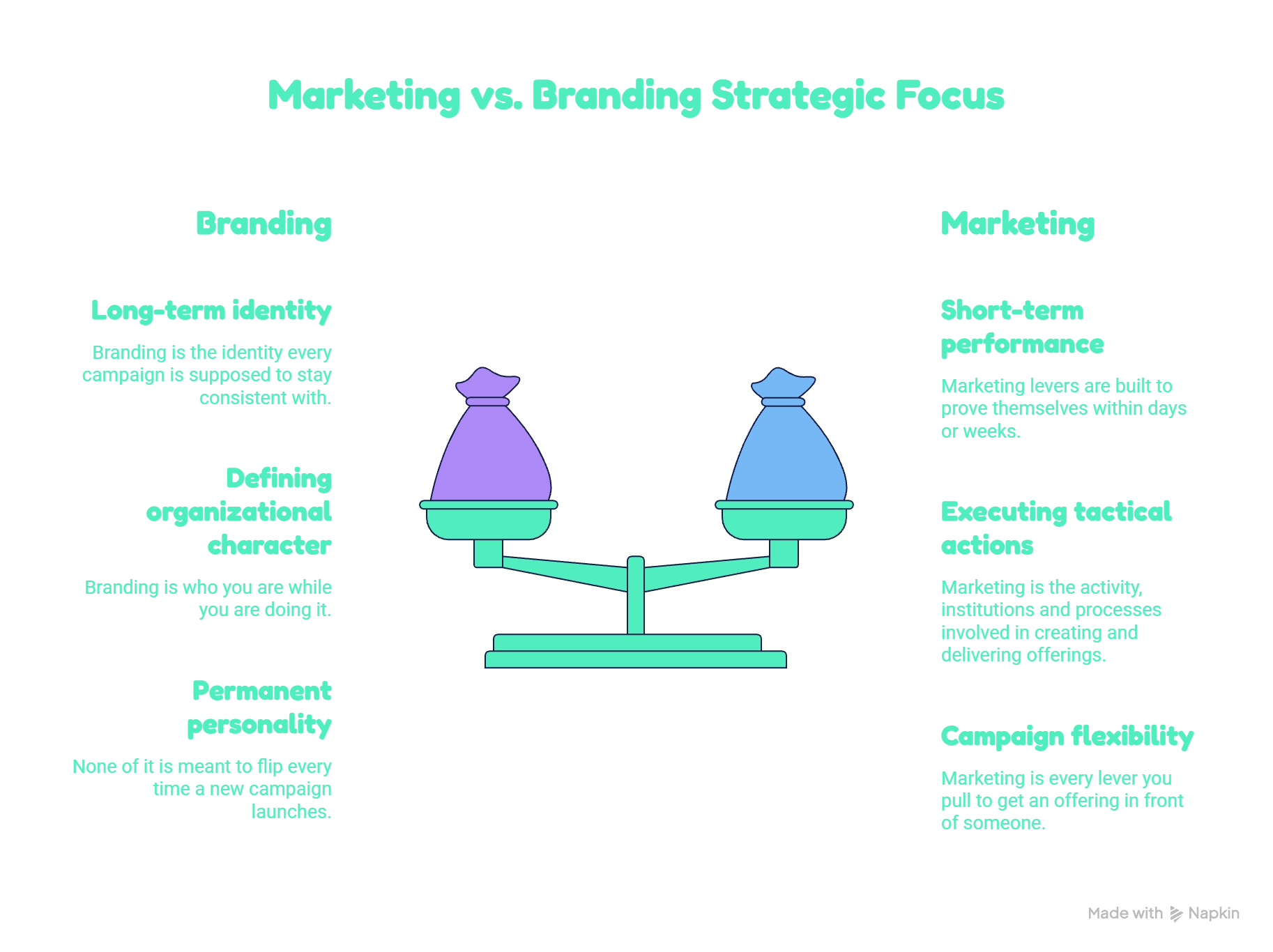
The American Marketing Association’s official definition describes marketing as the activity, institutions and processes involved in creating, communicating, delivering and exchanging offerings that hold value for customers and society at large, and buried in that dense sentence is a simple idea, which is that marketing is the doing word. It’s SEO, paid ads, email sequences, referral programs, social posts, cold outreach, every lever you pull to get an offering in front of someone and push them toward an action, and almost all of those levers are built to prove themselves within days or weeks rather than years.
You can see this in how marketing gets budgeted too. Gartner’s 2025 CMO Spend Survey put average marketing spend at 7.7% of company revenue for large firms, holding flat two years running, while The CMO Survey run jointly by Deloitte, Duke University and the AMA landed closer to 9.4% across a wider sample. The two numbers disagree slightly, which tends to happen whenever two different surveys sample different company sizes, but they’re both measuring the same underlying thing. Money spent chasing a result inside a defined window. That’s the marketing bucket, and it gets judged almost entirely on whether the campaign worked this quarter, not on how memorable the company felt five years from now.
What Branding Actually Means?
Branding doesn’t answer to the quarter, because branding isn’t a campaign, it’s the identity every campaign is supposed to stay consistent with. If marketing is what you do, branding is who you are while you’re doing it, and I’ve gone deeper into this idea already if you want the full breakdown of what a brand actually is.
Your name, your visuals, your tone, your values, the promise you’re making to anyone who runs into you online or offline, all of that sits under branding, and none of it is meant to flip every time a new campaign launches. A company that reinvents its personality every quarter the way it reinvents its ad copy isn’t really a brand yet. It’s just a business running promotions and hoping something sticks.
The Real Difference Between The Two
Once both definitions are sitting next to each other, the difference gets a lot less abstract.
|
What
|
Branding
|
Marketing
|
|---|---|---|
|
Answers
|
Who you are and why you exist
|
How people find out, and why they should act now
|
|
Time horizon
|
Years
|
Weeks or a single campaign cycle
|
|
Changes when
|
Your values or positioning genuinely shift
|
Trends, platforms or offers shift
|
|
Judged by
|
Recognition and trust
|
Clicks and conversions this quarter
|
|
Failure looks like
|
Nobody can describe what you stand for
|
Nobody even sees what you're offering
|
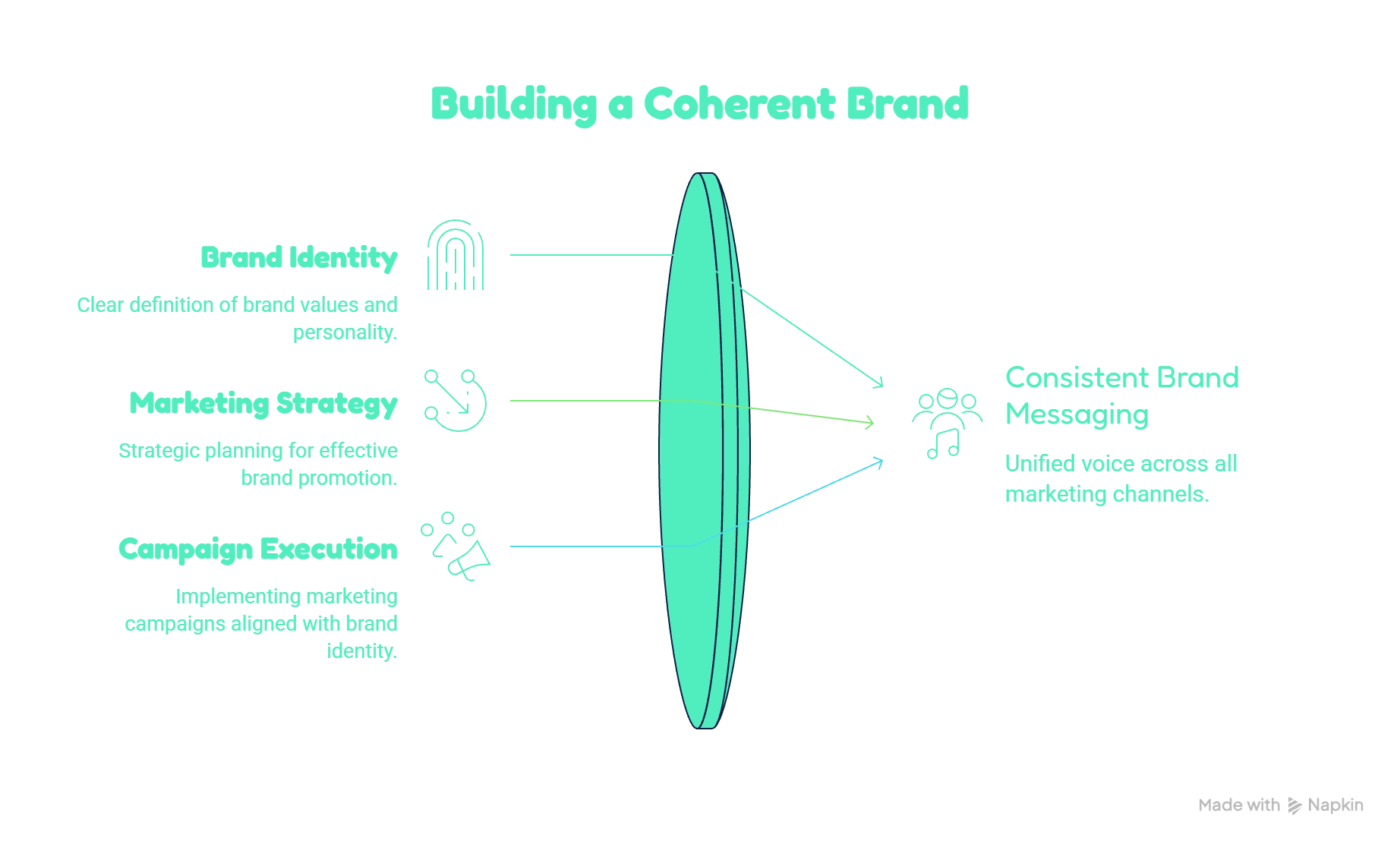
Most writing on this topic lands on some version of the same conclusion, that branding builds meaning while marketing distributes that meaning to the right people. It’s a useful way to put it honestly, because it puts both functions on the same team instead of making them compete for credit. You need meaning worth spreading, and you need a way to actually spread it, and neither one does much good sitting alone.
What Happens When Branding Backs The Marketing Up
If you’ve grown up watching Indian television or reading a newspaper, you already know the best case study for this without realising it. Amul has run the same character, the same polka-dotted Amul Girl, on the same style of hand-painted billboards commenting on whatever happened to be in the news that week, since 1966. Elections, cricket matches, film releases, none of it matters, the visual language and the wit stay exactly the same, and that consistency is what let Amul turn topical ads into a genuinely low-cost marketing engine. Reports peg Amul’s ad spend at under 1% of revenue even while it runs upwards of 250 fresh topical creatives a year, which only works because the brand underneath those ads never needs re-explaining. Nobody has to figure out what Amul stands for every time a new hoarding goes up. That work got done decades ago, so the marketing team just gets to be witty on top of it.
That’s branding doing its job properly. The identity holds steady for fifty-plus years while the marketing on top of it changes daily, and the two reinforce each other instead of fighting for the same budget line.
What Happens When It Doesn't?
Now flip to what happens when a company touches its branding the way it touches a marketing campaign, quickly and without warning. Gap swapped its iconic blue box logo for a plain Helvetica wordmark in October 2010, after twenty years of using the old one, and did it with no rollout plan and no explanation to the people who’d grown up shopping there. Within 24 hours a design blog had racked up over 2,000 negative comments, a protest account on Twitter picked up 5,000 followers, and a crowdsourced “make your own Gap logo” site collected close to 14,000 parody submissions. Gap reversed the whole thing within six days.
Here’s the part that matters for this post specifically. Gap’s marketing execution wasn’t the problem. The rollout was fast, the announcement was clean, nothing about the campaign mechanics was broken. What broke was the branding underneath it, decades of accumulated trust and recognition tied to that specific blue box, and no marketing polish could rescue a decision that ignored what the brand already meant to people. Marketing without a stable brand holding it up isn’t really marketing. It’s just activity that looks like marketing until someone checks.
Why This Confusion Actually Costs Money
None of this is a semantic argument only branding agencies care about. A survey of small business owners run by The UPS Store, covered by Fortune, found that “branding/marketing” was the single most common answer when owners were asked what they found hardest about running a business, ahead of both financial resources and time management. That tells you this confusion isn’t a beginner’s knowledge gap, it’s a genuine operational blind spot that’s costing actual founders actual clarity every single week.
And the cost shows up in a specific, avoidable way. When every marketing decision doubles as an unplanned branding decision, the logo, tone, colours and message all start drifting depending on whoever’s writing that week’s ad, and that drift has a price tag attached to it. Marq’s State of Brand Consistency report, built on responses from over 400 brand management professionals, put the estimated revenue lift from consistent branding somewhere between 10% and 20%, with later editions of the same research pushing the ceiling up to 33% for the most disciplined operators. Whatever the exact figure ends up being for you, the direction holds across every version of that study. A stable identity makes every rupee or dollar you spend on marketing afterward work harder, because people already half-recognise you before the ad even finishes loading.
Which One Comes First?
Branding, every single time, and this isn’t a new argument either since it’s the same conclusion What Problem Does Your Brand Solve was building toward too. You can’t optimise a campaign for a brand that doesn’t exist yet in any coherent shape, because every channel from SEO to Instagram ads eventually asks the same question in a different format, which is why should someone pick you over the ten other options they already know about. You can’t answer that consistently if the answer keeps changing depending on who wrote the copy that morning.
That doesn’t mean you need a finished brand book before you’re allowed to touch an ad account, plenty of businesses figure out their identity while they’re already running campaigns. It just means every marketing call you make gets checked against the brand rather than the other way round, so the brand stays the fixed point and the campaigns stay the thing that moves.
A Quick Way To Check Which Problem You Have
Worth running before you spend your next budget cycle fixing the wrong thing. If people who’ve already bought from you can’t clearly say what you stand for, or your tone feels noticeably different depending on which platform someone finds you on, or you keep quietly relaunching your identity every few months hoping the next version finally clicks, that’s a branding problem and no amount of ad spend fixes it.
If instead the people who do discover you clearly understand what you offer and mostly like it, but almost nobody’s finding you in the first place, or your conversion rate on the traffic you already have looks healthy while the traffic itself stays thin, that’s a marketing problem, and the identity underneath it is probably fine as is.
Push more traffic at a confused identity and all you get is more people bouncing off that confusion faster, so if you’re nodding along to the first paragraph, that work happens before the ad spend does.
What's Next in the Marketing Launchpad?
Now that marketing and branding are properly untangled, the next step in Phase 0.1 is figuring out where your brand should actually sit next to everyone else already fighting for your customer’s attention, which is what brand positioning covers. After that comes niche selection, since positioning only really works once you know exactly who you’re up against and exactly who you’re speaking to, something we already started unpacking in Who Is Your Target Audience.
Go from 0 to 1 In Digital Marketing
With
Psyden Crafts
Launchpad Resources
Launchpad Blogs
Everything exists for a reason and a brand is not any different. Each company you encounter if you look outside the screen you are reading this on solves some kind of problem so before you start marketing, ask your self What Problem Does Your Brand Solve?
If you have understood why your brand exists and what problem you are gonna take on, determining the target audience is the logical next step, your target audience is the one you are making content for in the hope of converting them into paying customers somewhere down the line.
