
Table of Contents
- Brand Voice , Explained Properly
- Brand Tone , And Why It's Not The Same Thing
- The Four Sliders That Actually Define Your Tone
- Why This Is Really About Delegation
- An Indian Example:The Zomato Reply Nobody Had To Approve
- Building Yours Practically
- How To Actually Build Yours?
- Validation - Could Someone Else Sound Like You?
- What's Next in the Marketing Launchpad?
What Is Your Brand's Voice And Tone?
Before you write a single caption or approve a single reply, you should ask one question, does your brand have a voice or does it just have opinions floating in your head. Someone comments on your Instagram post at 11pm on a Saturday and the person replying isn’t you, it’s an intern or a new hire two weeks into the job, and they don’t know what to say and they screenshot it and send it to you on WhatsApp instead of just answering it. You’ve already worked out where your brand sits but positioning lives in your head until it gets written down as an actual voice, and a voice which isn’t written down isn’t a voice, it’s just a habit only you know how to perform.
Brand Voice , Explained Properly
Mailchimp’s own content style guide puts this better than most marketing textbooks manage to and it starts with one line, your voice is who you are and it doesn’t change much from one day to the next, the same way a person’s personality doesn’t change whether they’re at a wedding or stuck in a work meeting. Kate Kiefer Lee wrote Mailchimp’s original guide and she defined their voice using four fixed adjectives, funny, clever, smart and helpful, and used those same four words as a filter for every single piece of writing the company put out, and if a sentence didn’t serve at least two of the four it got cut no matter how clever the writer thought it sounded.
That’s the part most brands skip and everyone can name a vague adjective or two, friendly, professional, but very few brands write down what those words mean in practice and that’s exactly why two different people writing for the same brand end up sounding like two different brands.
Brand Tone , And Why It's Not The Same Thing
Tone is the part that moves. Mailchimp frames it as the way your same underlying personality flexes depending on who you’re talking to and what’s actually happening, and you wouldn’t use the same tone thanking someone for a purchase that you’d use responding to a complaint, even though it’s still unmistakably you doing the talking either way.
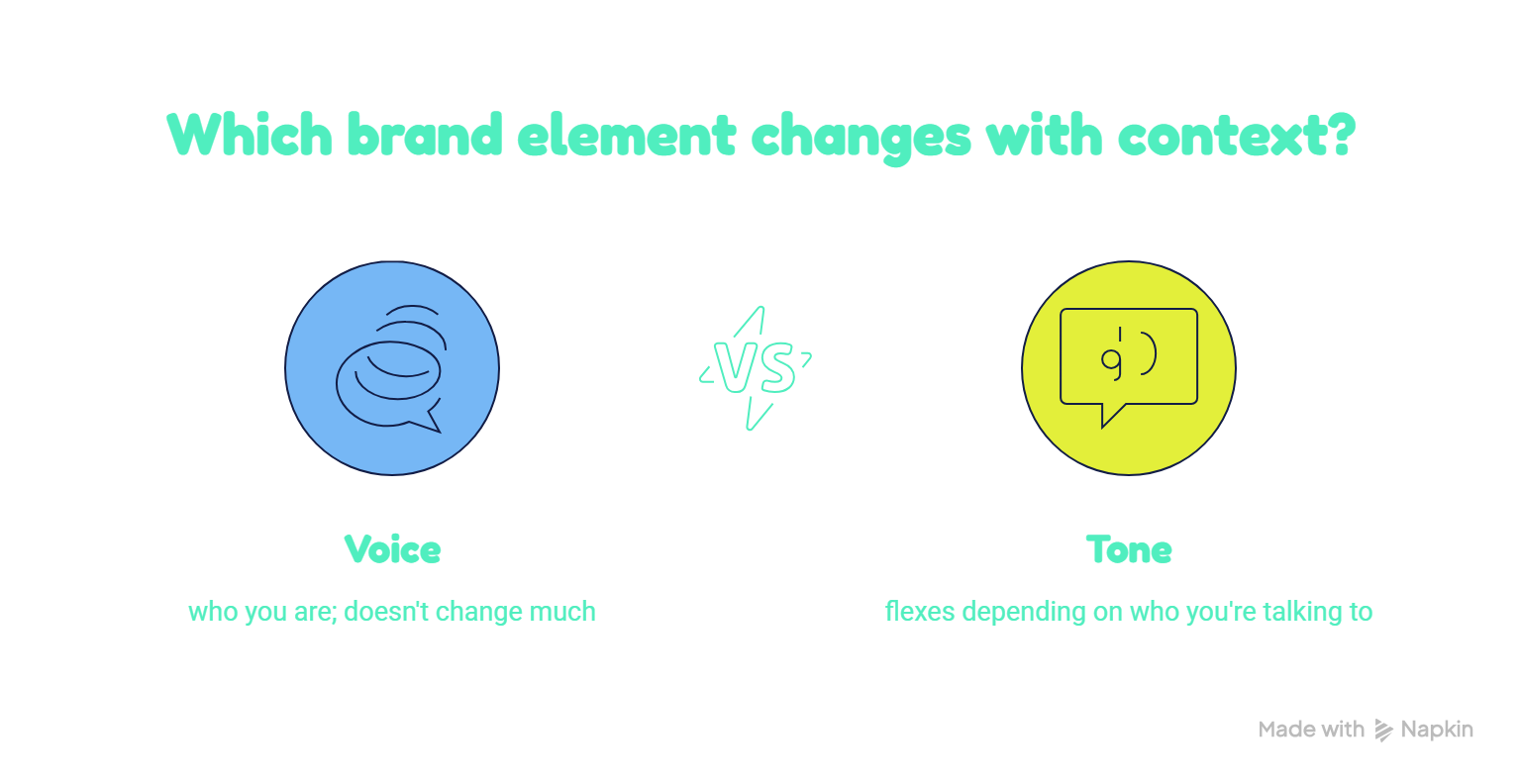
In simple words – Voice is who you are.
In longer words – Tone is how much of that personality shows up in any single moment, and it gets dialled up when you’re launching something exciting and dialled way down when a customer’s upset and the last thing they want right then is a joke landing at the wrong time.
The Four Sliders That Actually Define Your Tone
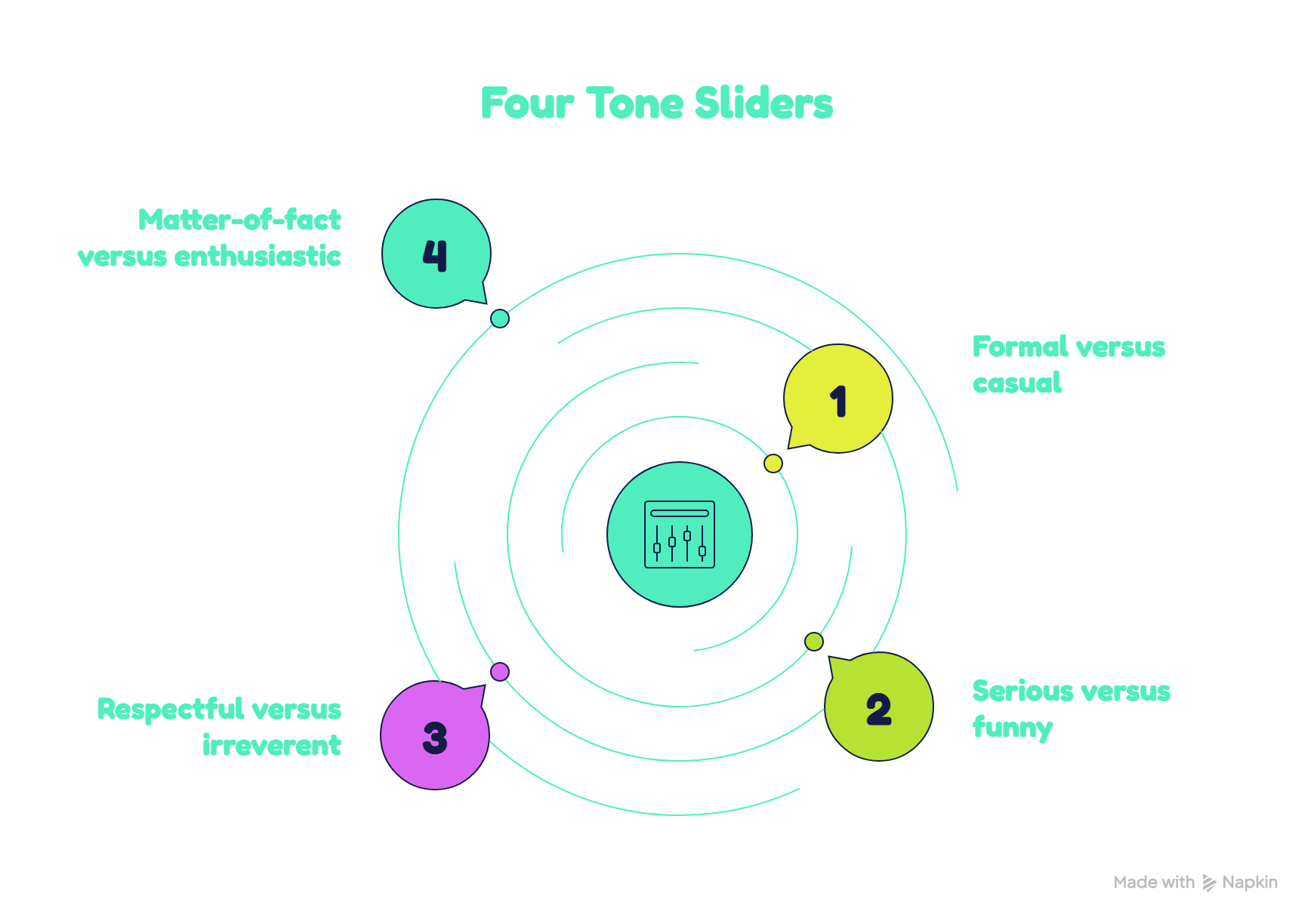
Adjectives alone are hard to act on and that’s why the Nielsen Norman Group’s research on this is genuinely useful, they broke tone down into four measurable sliders instead of leaving it as a vibe, formal versus casual, serious versus funny, respectful versus irreverent, matter-of-fact versus enthusiastic.
You don’t need to land at an extreme on any of these and most brands sit somewhere in the middle of each slider, and the exercise isn’t about being maximally funny or maximally formal, it’s about knowing roughly where you sit so a new writer doesn’t have to guess. A brand that’s casual, funny, respectful and enthusiastic reads completely differently from one that’s casual, funny, irreverent and enthusiastic, even though on paper those two descriptions look almost identical.
Why This Is Really About Delegation
Here’s the actual reason this matters more than it looks like it should. A voice and tone guide isn’t really a writing exercise, it’s a delegation tool, and the moment your brand has more than one person capable of posting or replying on its behalf you have exactly two options, either write down what your brand sounds like so a new person can act on it independently or have every single message routed back through you for approval before it goes out.
One analysis of this problem calls it the Frankenstein Effect, different team members or freelancers writing in conflicting styles because nobody ever documented the source of truth, and the result is a brand that sounds like several different people depending on who happened to be online that day. For a brand your size the cost of that isn’t abstract, it’s every message that has to wait for your approval instead of going out the moment it’s actually needed.
An Indian Example:The Zomato Reply Nobody Had To Approve
Zomato is worth studying here because its brand voice survived something most brands never test, years of different people rotating through its social media and customer support desks, and the voice barely wobbled. The most cited example of this is a single customer support chat that went viral entirely on its own, a customer typed “1 fish fry” and the Zomato support rep replied “Pani mein gayi”, the next line of a well-known Hindi rhyme about a fish falling in water, and the customer played along with “Chappak,” the final word of the rhyme, and Zomato later shared the screenshot themselves and it racked up hundreds of thousands of views.
Nobody approved that reply before it went out and it couldn’t have been approved, it happened in real time in a support chat, which means the only reason it worked is that the person typing it already knew, without needing to ask anyone, that this was exactly the kind of moment Zomato’s voice was built for. Analysis of Zomato’s broader communication approach points at exactly this, organisations that get this right define tone-of-voice guidelines and actually train frontline staff on them rather than hoping everyone independently develops the same instinct.
Building Yours Practically
Start with three to five adjectives the way Mailchimp did, but don’t stop at the adjective, for each one write down what it looks like in an actual sentence and what it doesn’t look like, because friendly without an example is just a word everyone will interpret differently. Then plot yourself roughly on the four NN/g sliders from earlier, formal to casual, serious to funny, respectful to irreverent, matter-of-fact to enthusiastic, and write one line explaining where you sit and why.
After that build a small list of words and phrases you actually use and a list you deliberately avoid, because banned words are often more useful than approved ones, they catch the moment someone’s about to write something that technically isn’t wrong but doesn’t sound like you. Finally write two or three example replies for situations you know will come up again and again, a compliment, a complaint, a request for information, so the next person handling your account has something concrete to pattern-match against instead of starting from a blank page.
How To Actually Build Yours?
This is exactly the kind of exercise that’s much easier to do on paper than in your head, which is why I put together a Brand Positioning Template you can pull up alongside this post. It walks you through mapping your real competitors, plotting your positioning map inputs, working out what’s genuinely different about you, and then building your own version of the For/Who/Is/That/Unlike/We statement from earlier in this post, section by section, the same way the target audience and problem validation worksheets from the earlier posts in this series did.
If you haven’t filled those two out yet, it’s worth doing them before this one, since your positioning statement only holds up if it’s built on an audience and a problem you’ve already validated rather than guessed at.
Validation - Could Someone Else Sound Like You?
The real test of a voice and tone guide isn’t whether you like reading it, it’s whether someone else can use it without you in the room.
Voice Clarity Questions
- Could a new hire read this guide and write a believable reply to a customer comment without asking me first?
- Do I have actual example sentences written down or just adjectives that sound nice but mean nothing specific?
- Is there a list of words or phrases we deliberately avoid, not just ones we use?
- Have I written down how tone should shift for at least one difficult situation like a complaint or a mistake?
- If two different people on my team wrote a caption for the same post would they sound like the same brand?
Note – Before moving to the next step of the Launchpad, complete this statement:
My brand’s voice is __________
which means we never sound __________
and here’s what that looks like in one real sentence: __________
What's Next in the Marketing Launchpad?
With your voice actually written down instead of just felt, the next step in Phase 0.1 is niche selection, and a specific, well-defined voice tends to work best once you already know exactly who you’re narrowing in on and speaking to.
Go from 0 to 1 In Digital Marketing
With
Psyden Crafts
Launchpad Resources

Launchpad Blogs
Marketing and branding get used so interchangeably in job titles, agency pitches and every second LinkedIn post that most people never actually stop to ask where the line between them sits
Every product on a shelf, in an app store or on a search results page is fighting for the same three seconds of attention and positioning is the only thing that decides who actually wins it.
