What Problem Does Your Brand Solve?
Everything exists for a reason and a brand is not any different. Each company you encounter if you look outside the screen you are reading this on solves some kind of problem so before you start marketing, ask your self What Problem Does Your Brand Solve?
Problems are natural and you can’t and shouldn’t monetize that. Solution is the reason why you see hordes of people travelling back and forth everyday to their jobs. Everyone of them is a part of a company (Govt or Pvt) which solves at least one problem in existence.
Why People Buy Solutions, Not Products
Solutions are what sell. Products are simply the medium of transaction. Think about everything you’ve ever bought. Some purchases were impulsive, some were gifts and some genuinely improved your life. But almost every purchase was made because you believed it would solve a problem. Sometimes that problem disappears. Sometimes the product never solved it in the first place. Either way, it was the promise of a solution that convinced you to buy.
A simple example would be a food delivery app. A person isn’t opening the app because they like the app itself, the actual solution is the food choices, convenience and most importantly hunger. App is just the product, solving the craving with ease is the solution.
This is one of the major reasons why companies fail as they spend the majority of their time thinking about what they wanna sell rather than what customers actually want. Nobody wakes up thinking about the app itself, they wake up thinking about their problems and any brand that comes with a solution for the same earns their amount of the person’s fortune.
The more specific and niche the problem is, the more precise the solution has to be.
Shaping your customer perception to what you wanna be associated with is called Branding. No brands want to get called the cheapest option but being called affordable to your alternatives is where they accept the bargain because keeping a business running is an obvious choice in comparison to running with a delusional perception which turns your balance sheet red.
Pain Points and Wants
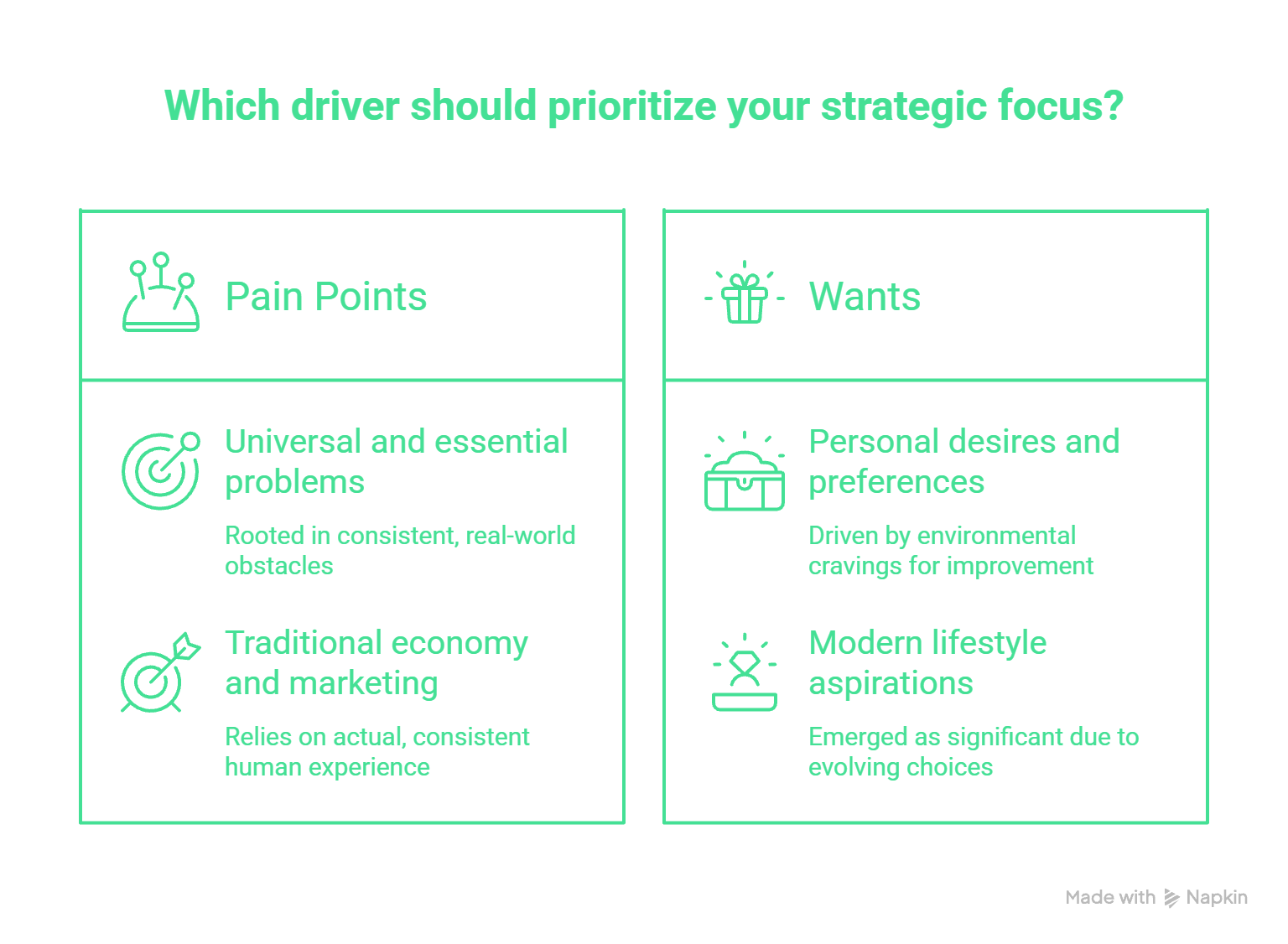
Every purchase begins with mostly 2 points, pain points or wants.
Understanding the difference between the two will help you market your product in the way that resonates with your potential customers the most.
Pain Points
Pain points are problems, frustration and obstacles people are constantly looking for a solution for. They are more universal essential.
These are where the traditional economy and marketing thrives as they are more real, consistent and based upon actual experience of the people.
Problem – A simple example is waiting for a taxi to reach your flight on time, you would have to wait on the main road and hope to catch an empty one on your route who is willing to take one more ride to your stop and it all costs a reasonable amount.
Pain points are problems, frustration and obstacles people are constantly looking for a solution for. They are more universal essential.
These are where the traditional economy and marketing thrives as they are more real, consistent and based upon actual experience of the people.
Problem – A simple example is waiting for a taxi to reach your flight on time, you would have to wait on the main road and hope to catch an empty one on your route who is willing to take one more ride to your stop and it all costs a reasonable amount.
Solution – Uber and Rapido have solved this problem wherein you are offered upfront fare, time to reach your destination while tracking, driver information and other security features make the switch to a new solution an easier and logical process.
Wants
Wants are specific desires which aren’t essential for survival but are based on more personal choices and preferences and satisfy people craving a better life or experience and are based more on the surrounding environment rather than something which affects them due to universal factors like pain points.
These have only recently became more significant but they still solve a problem nonetheless.
Problem – You are into fitness and have recently started taking upon 10K/day steps and is tracking the same on mobile which seems to come with some inconveniences like wrong tracking, carrying mobile during runs and checking the same after every sprint.
Solutions – Fitness watches that especially solves this problem which provides solutions to all of them.
Wants are driven more by desires than necessity In a nutshell. Although the line isn’t always clear and a product can solve pain points of one individual while being just a want of someone else.
A simple example can be a laptop which can be a pain point for a broke student who just wants to learn tools to keep with the latest technology while the same laptop can be just a want for a tech reviewer who wants to upload the review before his competition. A brand would happily sell to them both but marketing for both the audiences won’t be the same.

How do businesses communicate that they solve people problems?
Every marketing campaign by companies are focused towards amplifying the benefits the customers will rope after getting the product.
The simple answer is they talk about benefits more than their features and every new launch converts into either a solution for a pain point or a desire to be fulfilled.
Features and Benefits
Features are the technical and factual attributes of the product, they are what the core team handles and improve with every version and they ranges from a simple colour of the product to active noise cancellation in latest model. They are the ‘what’ of the product.
Benefits on the other hand talks about what those features can do for your customer and that noise cancellation converts into a peaceful mind during the commute for your customer. They are the ‘why’ of the product.
Features are about while benefits are about the customer.
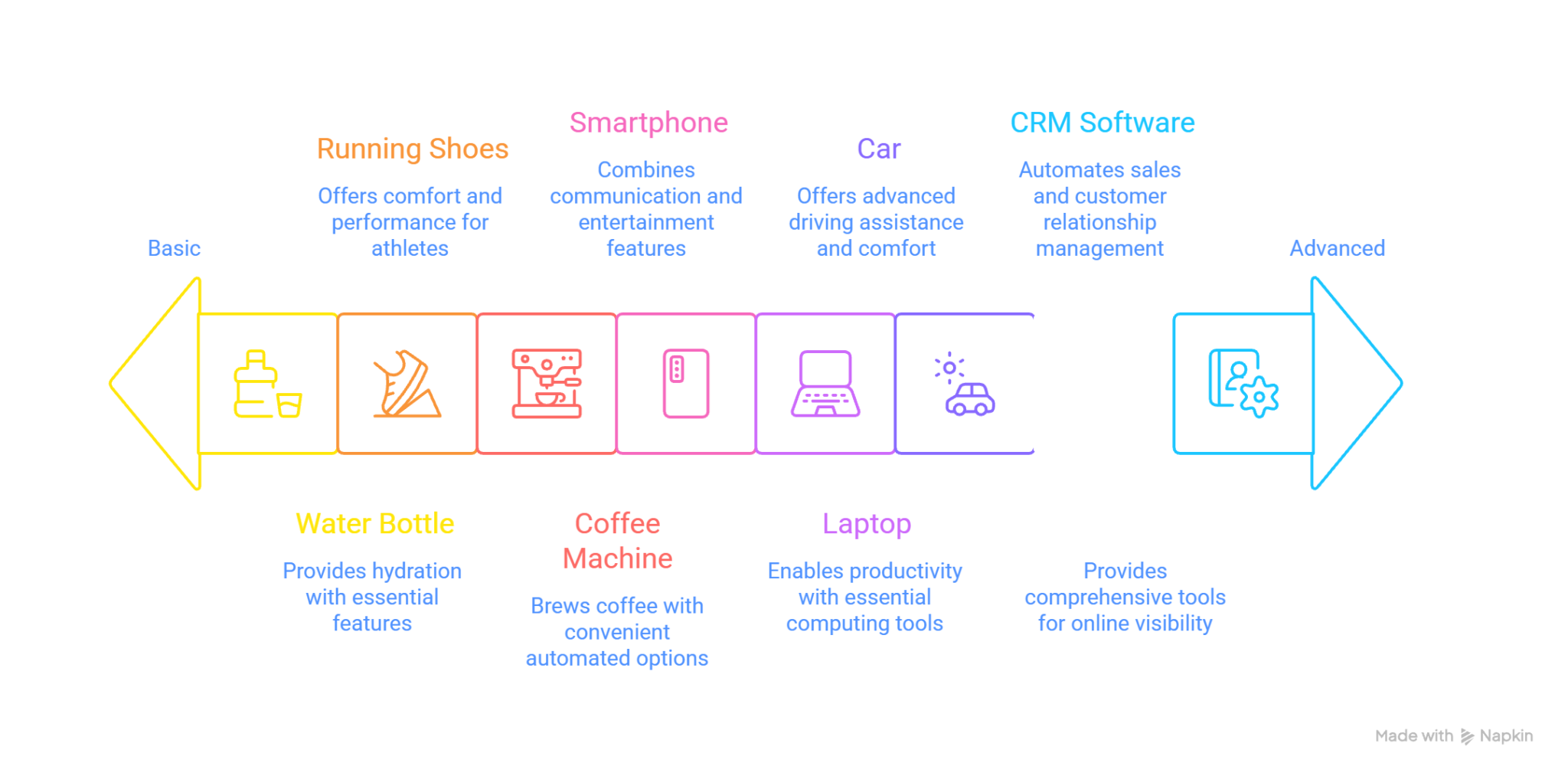
Some common features across the sectors and their benefits are

Validation - Is Your Brand Solving a Problem or Looking for One?
Anything after this particular phase won’t make sense till you get a clear idea of where your brand lies in a simple question about what you do and what problem you solve.
Your target audience, your conversion would be a second line of topic which will be asked to you. What you bring to the table will be asked before you are invited inside the room. The more thorough your research is at this stage would solve a lot of columns in the spreadsheet later on.
Ask yourself these questions before you carry forward with the course. All the topical clusters, Internal linking or technical portion won’t come in handy before some important basics are clear and one of them is validation.
Problem Validation
- What problem does my brand solve?
- Is this a real problem or something I assume exists?
- How often does this problem occur?
- How frustrating is this problem for the people experiencing it?
- What happens if nobody solves this problem?
Customer Validation
- Who experiences this problem the most?
- Do I know any one person who will benefit from my brand?
- Where do these people currently look for their problems?
- What words would they use to describe this problem?
Solution Validation
- How are people solving this problem today?
- Why isn’t the current solution good enough?
- What makes my solution different or better?
- Would I choose my own solution over the alternatives if given the choice?
Brand Validation
- If someone asked me, “What does your brand do?” Could I answer it in one sentence?
- Can someone explain my brand to another person without confusing them?
- What do I want people to remember about my brand?
Long-Term Validation
- Would people pay for this solution?
- Would they recommend it if it genuinely helped them?
- Is this a problem that will still matter a year from now?
- Can my brand continue solving this problem as it grows?
Note : Before moving to the next step of the Marketing Launchpad, complete these three statements:
My brand helps __________
solve __________
so they can __________
Go from 0 to 1 In Digital Marketing
With
Psyden Crafts
Check Out Marketing Launchpad