
Table of Contents
- The numbers, quickly
- Step One, Figure Out Which State Your Account Is Actually In
- When "verify you're human" becomes a dead end
- The Complete Category Breakdown
- 1. Inauthentic Behavior
- 2. Platform Manipulation and Spam
- 3. Hateful Conduct
- 4. Violent Speech
- 5. Account Security and Compromised Accounts
- 6. Copyright Infringement (DMCA)
- 7. Impersonation
- 8. Child Safety Violations
- 9. Illegal or Regulated Goods, and Counterfeit Items
- 10. Ban Evasion
- 11. New Account Plus a Fast Premium Purchase
- When Even X's Own Rules Might Be Getting Broken?
- The Actual Appeal Playbook
- What The Odds Actually Look Like
How To Get Your X Account Unbanned For Every Suspension Type?
This is the second post in a series I’m running on X’s suspension problem. The first one covers my own case in detail, banned twice for the same reason, won the first appeal and lost the second one with almost the same explanation both times. This post zooms out from that. It’s a full breakdown of every major suspension type on X, what actually sets each one off, and what real people have done to get their accounts back.
X suspends accounts at a scale that’s honestly hard to picture. In its own H1 2024 transparency report, X admitted to suspending nearly 5.3 million accounts in six months, more than triple what it suspended in the same period two years before, and it pulled or labeled over 10.6 million posts on top of that. Break it down by category and the enforcement numbers get even more specific.
The numbers, quickly
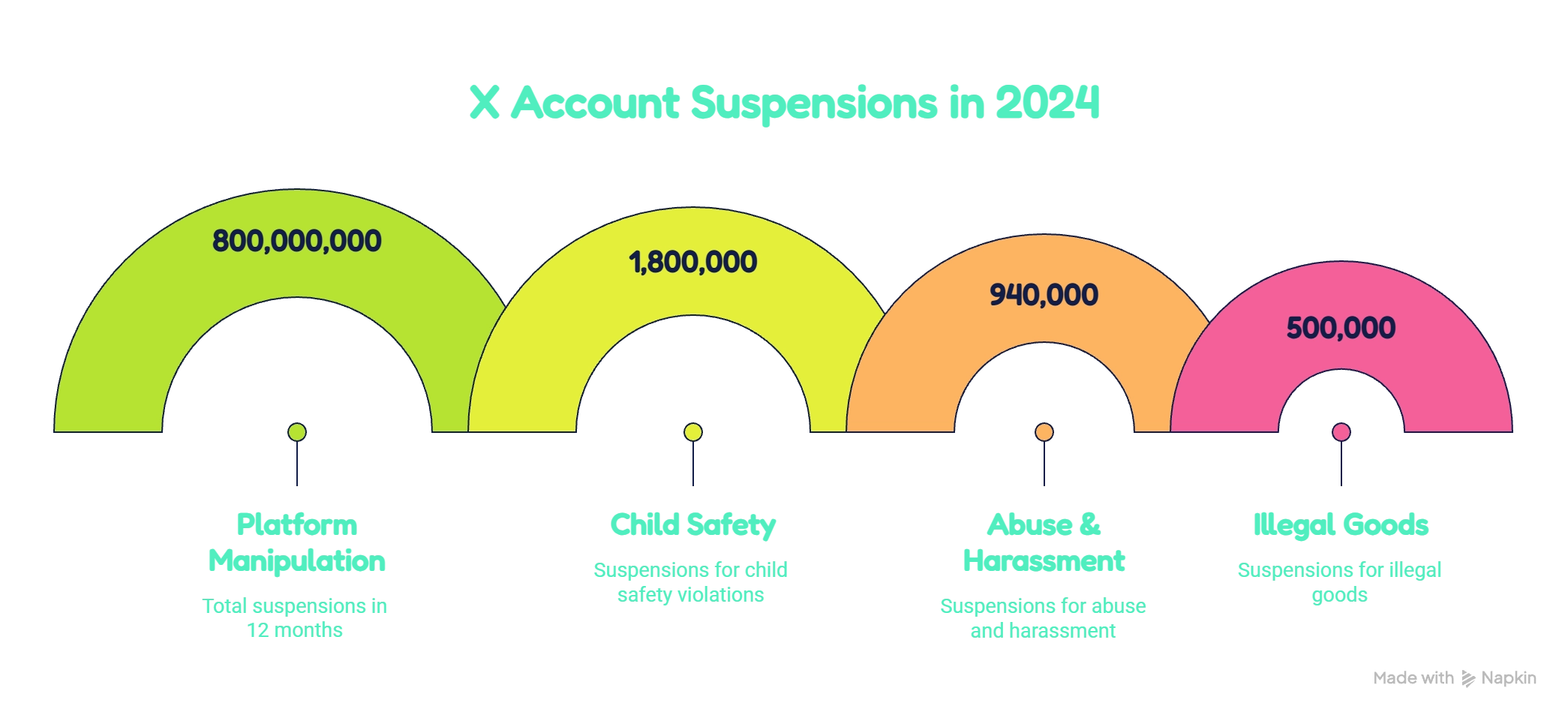
- 940,000+ accounts suspended for abuse, harassment, and hateful content in the second half of 2024, and only 340 of those were flagged by machine learning, the rest came from human reports.
- 1.8 million accounts suspended for child safety violations in that same window, tied to over 313,000 reports filed with the National Center for Missing and Exploited Children.
- 500,000+ accounts suspended for buying or selling illegal or regulated goods.
- Roughly 800 million accounts suspended in a single 12 month stretch for platform manipulation and spam, according to testimony given to UK lawmakers, against a user base of only around 550 to 600 million monthly actives.
Real accounts get caught in that net constantly alongside the actual bots and scammers, and almost nobody gets a real explanation of what tripped it. That’s the gap this post is trying to close.
Step One, Figure Out Which State Your Account Is Actually In
X doesn’t run one punishment, it runs four, and mixing them up wastes time chasing the wrong fix.
The Four States
|
What You See
|
What It Actually Is
|
How Long It Lasts
|
|---|---|---|
|
Login works, but you can't post, retweet, or like
|
Read-only / limited mode
|
12 hours to 7 days, usually clears itself
|
|
Login asks for a phone or email code
|
Locked account, security check
|
Minutes, once verified
|
|
Your account has been suspended" on login
|
Full suspension
|
Temporary: 1 to 7 days. Permanent: indefinite, appeal only
|
|
You can post fine, but nobody sees your replies and reach has cratered
|
Shadowban / visibility filtering
|
Typically 2 to 14 days, totally separate from suspension
|
The last one trips up more people than anything else on this list. A shadowban has no appeal form at all, because X doesn’t treat it as an official enforcement action the way it treats a suspension. So if your account technically still works but engagement quietly died, filing a suspension appeal does nothing, since you were never actually suspended in the first place.
There’s also a nastier version of the locked account state that’s worth calling out on its own, because it can trap you with no way through at all.
When "verify you're human" becomes a dead end
A reader on the last post’s Reddit thread, who goes by snarkpix, laid out a version of this that’s worth reading in full. They only use X on desktop, and got hit with what looked like a Cloudflare “verify you’re human” check that failed automatically every single time, then redirected to a blocked login plus a QR code. Following the QR code led to a message saying the verification only works on mobile. Following it on mobile from there originally said verification kept failing until an “install the app to verify” prompt appeared, which, once news coverage picked up on how misleading the flow was, changed to openly admit it wanted biometric data.
They only had one mobile phone, used for work, and weren’t willing to hand biometric data to a third party through it. Which left them stuck in a genuine problem:
- X won’t even let them file an appeal, because technically the account isn’t “banned,” it’s just blocked from logging in
- The support page itself redirected straight back into the same verify-slash-QR-code loop
- No VPN, no unusual browsing setup on their end, just Firefox with site containers and standard ad blocking
Their account was personal use only, mostly following a handful of sci-fi authors and doom-scrolling, not a business or paid account. Worth sitting with that for a second, this wasn’t a bot, wasn’t automated, wasn’t running anything unusual, and still ended up with functionally no path back in.
If this happens to you: try switching devices entirely before assuming you’re stuck, since the failure pattern above seems specific to the desktop-to-mobile handoff. If you don’t have a second phone available and don’t want to install anything requiring biometric access, there may not be a clean fix right now beyond waiting and periodically retrying, since this flow sits outside the normal appeal system entirely.
The Complete Category Breakdown
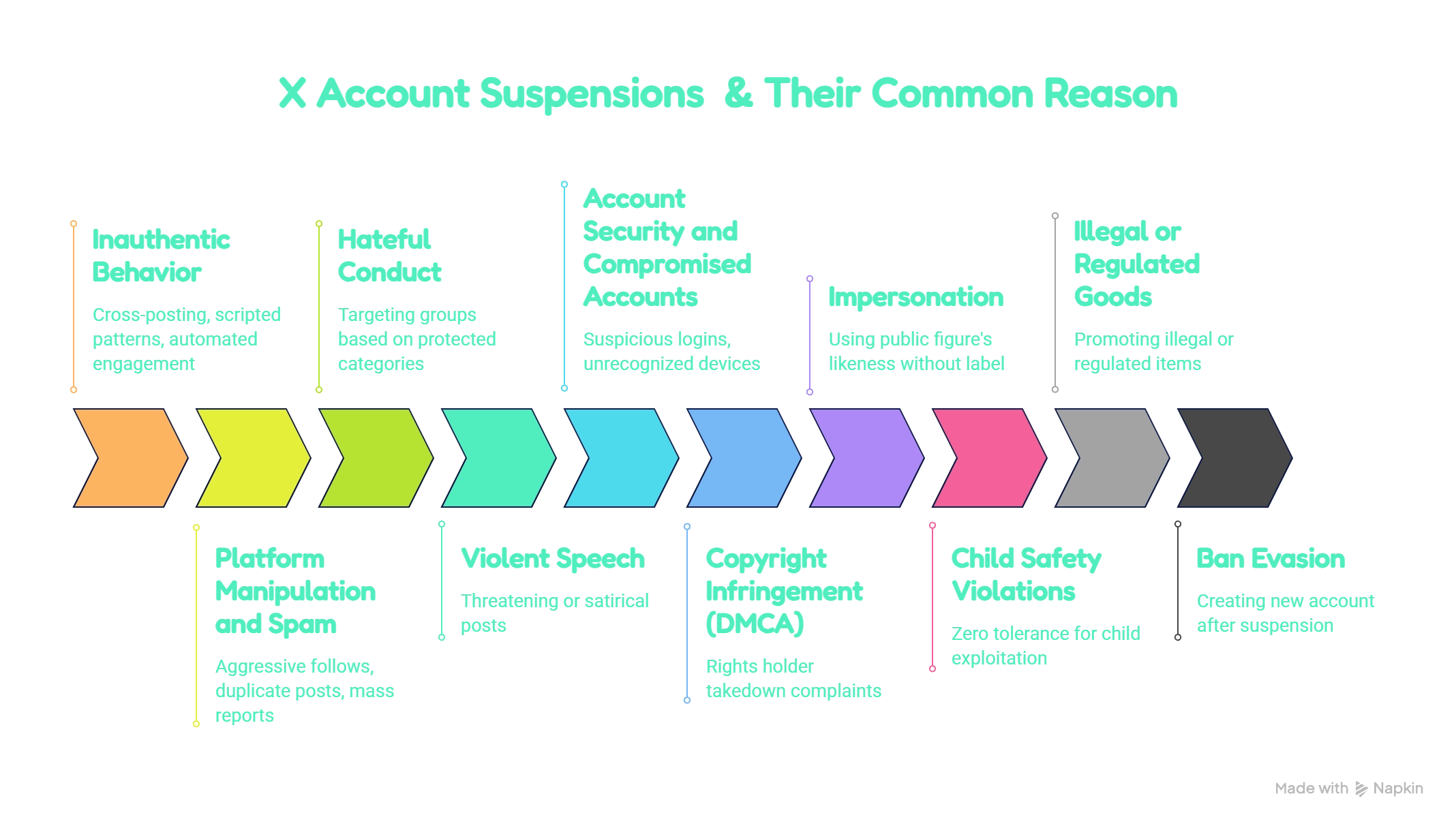
X groups everything into three official buckets, spam, security risk, and abusive behavior, but the labels people actually see on the suspension screen get a lot more specific than that.
1. Inauthentic Behavior
What triggers it:
- Cross-posting the same content across platforms with different captions
- Unusually consistent or scripted-looking posting patterns
- Engagement that reads as automated even when a real person is behind it
- Multiple accounts run by the same person, which X’s authenticity policy explicitly allows it to link and suspend together
This is the category with the least transparency of any on the list, most people who get hit genuinely can’t point to a specific action that caused it. My own case, and the full story of getting banned twice for exactly this, is in the first post in this series.
Real cases:
- One user bounced between ghost banned, visibility-reduced, and finally suspended for “inauthentic activity,” despite never posting anything they’d call inauthentic
- Another got locked out just for scrolling their feed and occasionally liking or replying, and couldn’t even file an appeal since the account showed as “not suspended” while login stayed blocked
- A third got reinstated after a “prove you’re not a bot” link, but said engagement never fully recovered afterward
What tends to work: a specific, detailed explanation of how the account is actually run and who’s behind it, not a vague denial.
2. Platform Manipulation and Spam
What triggers it, per X’s own enforcement options page:
- Aggressive follow and unfollow behavior, especially past roughly 400 follows a day
- Duplicate or near-duplicate posting across accounts or in quick succession
- Mass reports from other users, even wrong ones, since volume alone can bump an account into manual review
- Auto DMs from any third party tool
- Simply being new, accounts under 30 days old face much tighter automated thresholds
This is the single largest bucket by volume of anything X tracks, and it’s where that roughly 800 million figure from earlier comes from.
Real cases:
- One account with 249,000 followers stayed locked for four months, getting nothing but instant automated rejections
- Reddit user Sharp_Radio_672 caught something worth flagging directly: they timed a third appeal being auto-rejected in under 5 to 10 seconds and recorded it happening in real time. That’s not a human reading anything, that’s a script
What tends to work: persistence, more than any specific wording. Across dozens of documented cases, restorations clustered around the fifth appeal attempt, spaced roughly 48 hours apart. People who stopped after one or two rejections tended to stay banned, people who kept going eventually got through.
3. Hateful Conduct
Per X’s hateful conduct policy, this covers targeting individuals or groups based on a protected category, race, ethnicity, national origin, sexual orientation, gender, gender identity, religion, age, disability, or serious disease. It’s tied to one specific reported post rather than the whole account, which separates it from the pattern-based categories above.
Real cases:
- One user documented sending appeals over three straight weeks, getting nothing but automated bot denials each time
- Another spent months demanding specifics on exactly what they’d said wrong and never got an answer
- On the flip side, Tommy Robinson and Katie Hopkins, both suspended years earlier for hateful conduct, were reinstated in bulk under a general amnesty after Elon Musk’s takeover. BBC Monitoring later checked 1,100 reinstated accounts and found nearly 190 still promoting hate and violence
What tends to work: a calm, non defensive acknowledgment of the specific rule cited, plus a plain statement the post wasn’t meant as harassment. Worth being honest, this is one of the lowest first-appeal success rate categories on the whole list.
4. Violent Speech
Its own separate label from hateful conduct, per X’s rules index, usually triggered by one specific post read as threatening, even sarcastic or clearly satirical ones.
Real cases:
- One activist got suspended over a dark joke, spent two months appealing, and only got reinstated after agreeing to delete the post, despite believing it had been misread
- Someone else was suspended under X’s child sexual exploitation policy for posting a widely circulated news photo, and directly challenged the logic of the label in their appeal
What tends to work: if you can identify the flagged post, offering to delete it moves an appeal much faster than arguing it was fine. Save the argument for after you’re back if you want to make it publicly.
5. Account Security and Compromised Accounts
Not a punishment, this one is X trying to protect you, per its own suspended accounts help page.
What triggers it:
- Suspicious logins
- An unrecognized device
- A password that showed up in an unrelated data breach elsewhere
- Logging in from a new country without two-factor authentication on
Real case: actress Swara Bhasker’s account was initially locked over an alleged copyright issue. While trying to resolve it, she clicked what looked like an official X appeal link, entered her credentials, and it turned out to be a phishing page that genuinely compromised the account as a result. X restored it once ownership and security were confirmed.
What tends to work:
- Enable two factor authentication before anything else
- Revoke all connected third party app sessions
- Verify ownership only through the official channel, never a link in an email or DM claiming to be X support
6. Copyright Infringement (DMCA)
Triggered by a rights holder filing a takedown complaint, not an automated behavior detector, and it runs through a completely different internal process from everything else on this list.
Real case: the same Bhasker case above, two images she’d posted were flagged as copyright violations before the phishing incident compounded things.
What tends to work: documentation of ownership or a valid license. Generic “I’m not a bot” templates simply don’t apply here since bot detection was never the issue.
7. Impersonation
Using a public figure’s or brand’s name, photo, or likeness without a clear parody, fan, or commentary label, per X’s authenticity and impersonation rules.
What tends to work: add explicit parody or fan account labeling to the bio and display name before appealing, and reference that specific change in the appeal text. Like hateful conduct, this has a notably low first-appeal success rate.
8. Child Safety Violations
X’s strictest category by a wide margin. Its own child safety policy states zero tolerance, and the consequences reflect that. If an account is suspended under this policy specifically, X states you also lose access to any X Money balance, remaining funds get mailed to you by check instead.
The scale: 1.8 million accounts suspended in six months, over 313,000 NCMEC reports, and the overwhelming majority manually reported rather than automatically flagged.
What tends to work: honestly, almost nothing once an actual suspension has landed here, even in cases involving nothing sexual at all, like the news photo example above. If you genuinely believe you were caught by a false positive, your appeal needs to name exactly what specific content was misread and why. A vague appeal in this category is close to guaranteed to fail.
9. Illegal or Regulated Goods, and Counterfeit Items
Triggered by buying, selling, or promoting anything regulated or illegal, weapons, drugs, and counterfeit goods being the most common.
The scale: over 500,000 accounts suspended in six months, and the majority flagged manually by user reports.
What tends to work: remove the flagged listings or posts entirely before appealing, and be specific about exactly what was corrected. Sellers dealing with similar counterfeit flags on eBay and Google Ads report the exact same pattern, appeals framed around a completed fix land better than appeals that just deny the claim.
10. Ban Evasion
Creating a new account after a suspension on an old one. X’s own ban evasion policy states plainly that if one account is suspended, it reserves the right to suspend any other account it believes the same person operates, no matter when that second account was created. New accounts get linked back through device fingerprint, IP address, phone number, and email, so this isn’t hard for X to detect.
What tends to work: nothing, structurally, and that’s really the point of including this one. A new account doesn’t erase the original suspension, it just adds a second violation and usually damages the appeal on the account you actually wanted back.
11. New Account Plus a Fast Premium Purchase
A brand new account that immediately buys a Premium subscription and gets suspended within 24 to 48 hours, before ever meaningfully using it. Fast subscription activity on a zero-history account reads as a fraud signal to whatever’s scoring new sign-ups.
Real case: one user created a new account, bought a full year of Premium, and was suspended two days later with two unanswered appeals since.
What tends to work: genuinely mixed. Several people in this exact spot gave up on appealing entirely and just requested a chargeback instead, since there isn’t a well-documented success path for this specific combination yet.
When Even X's Own Rules Might Be Getting Broken?
One more thing worth adding here, since it’s a real angle nobody else seems to be covering.
Sharp_Radio_672, replying on the last post, said something worth taking seriously. On top of catching their own appeal getting auto-rejected in under 10 seconds, they mentioned they’re pursuing their country’s consumer law tribunal, since being suspended while holding an active paid subscription may actually break local consumer protection law, on top of a few other issues they described as having real “PR nightmare” potential if media picked it up.
Worth being clear that this isn’t legal advice and every country’s consumer protection framework is different. But if you’re paying for X Premium and get suspended with no refund and no functioning appeal, that combination might be worth raising with a local consumer protection body or ombudsman, not just X support. It’s a genuinely underused angle compared to just hammering the appeal button.
The Actual Appeal Playbook
Strip the category-specific advice out and there’s one structure that shows up again and again across people who eventually got their accounts back. The most detailed version comes from someone who documented their own month long, five appeal recovery step by step.
Compressed down to nine steps
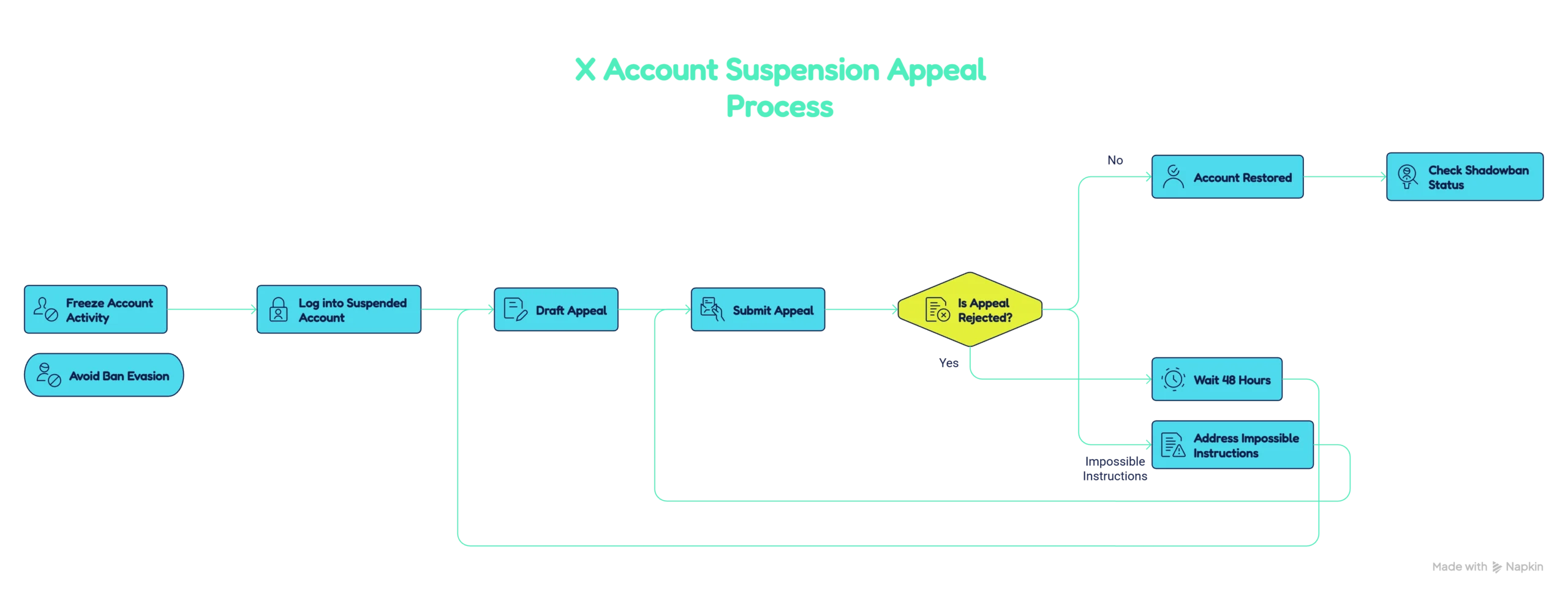
- Freeze the moment you see any warning label. Don’t post, don’t delete anything, don’t change your bio or avatar. Many soft labels expire on their own within days to a few weeks if left alone.
- Log into the suspended account first, then open a new tab for the official appeal form. Appeals filed from a logged-out browser sometimes get routed wrong.
- Write three to five sentences. Factual. Boring. No emotion. Name the specific rule cited, give one line of real context, state plainly you understand the rule and won’t repeat it.
- Never send the same letter twice. Repetition is one of the most commonly cited reasons appeals get auto-rejected before a human ever reads them. Rotate the angle each time, human proof, then identity and ownership, then a direct reference to the cited rule.
- Appeal roughly every 48 hours if rejected, and don’t stop after one no. The five-appeal pattern shows up across completely unrelated suspension categories, not just one.
- Never create a new account to get around it. That’s a ban evasion violation on top of whatever you were already dealing with, and it’s detectable.
- If X’s rejection tells you to “fix the violation” while you have no access to fix anything, say exactly that back to them. One documented case got restored within an hour after pointing out X’s own instructions were literally impossible to follow while suspended.
- Once you’re back, don’t touch anything for about 48 hours. Followers, following, and posts often come back gradually, and posting right away can complicate a fragile restoration.
- Check whether you’re still shadowbanned after the suspension lifts. Getting unsuspended and getting your reach back are two separate fights, and X never notifies you when a lingering visibility filter finally clears.
What The Odds Actually Look Like
Being blunt matters more than false optimism here.
Rough honest ranking
- Often succeeds on a first, clear appeal: spam and platform manipulation, account security lockouts, new-account verification issues
- Succeeds with persistence, usually by the third to fifth appeal: inauthentic behavior, copyright disputes with valid documentation, illegal or counterfeit goods once the listing is removed
- Rarely succeeds, even with a strong appeal: hateful conduct, harassment, impersonation
- Almost never succeeds once an actual suspension has landed: child safety violations, ban evasion
None of this is a fully clean system on X’s end either. X has publicly confirmed disciplining employees caught taking bribes to manually reinstate suspended accounts, a large share tied to cryptocurrency related suspensions specifically. Wikipedia’s own documentation of X’s suspension history also notes that both the copyright and spam detection systems have historically been manipulated by coordinated groups trying to force a suspension onto someone else’s account, worth remembering if your suspension traces back to a wave of reports rather than anything you actually posted.
Getting an account back, across nearly every category here, doesn’t look like winning an argument about what you did. It looks like being specific, staying calm, and outlasting a queue that mostly runs on volume rather than individual judgment.